|
by Hans Durrer
Español
One
of my problems with photography, especially documentary photography,
is that it is intrusive. To alleviate this problem, regardless
whether it concerns press photos or portraits, photography
needs the collaboration between photographer and subject.
"War Photographer", a documentary by Christian
Frei about the work of the photographer James Nachtwey, was nominated
for an Oscar (in 2002) and won twelve international film festivals.
Two
mini video recorders placed on Nachtwey's camera allowed the
viewers to see what the photographer was seeing. In Kosovo:
a crying woman. People try to comfort her. She has just learned,
one suspects, that someone close to her — maybe her son, maybe her husband? — was
killed, or found in a mass grave? We are not told, we do not
know, we are left guessing. Neither do we know what the photographer
knows. We see what the photographer sees: a woman crying, her
face full of pain, women who try to calm and comfort her. Nachtwey
is getting closer and closer, he aims the camera at her face
and ceaselessly presses the button. How is he able to do that?
Doesn't he feel awkward, and embarrassed? Doesn't he have scruples? |

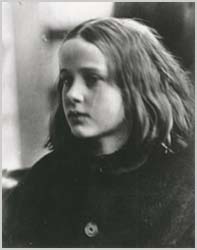
Annie,
My First Success; photograph
by Julia Margaret Cameron, 1864 |
On
the website
of this film,
this quote by Nachtwey can be found: "Every
minute I was there, I wanted to flee. I did not want to see this.
Would I cut and run, or would I deal with the responsibility of
being there with a camera?" In the film we can hear him more
than once stressing the importance of having respect. He also says
he understands himself as being the spokesperson for the ones he
portrays.
I'm glad that Nachtwey's photos exist and remind us of things
we would probably rather not be reminded of. I want to believe
his good intentions. Yet, I also feel that there is something wrong
with this kind of photography because the ones portrayed are used;
they have no say in how they are depicted and later are put in
pages of books, or hung on walls.
Let's
look at Nachtwey's rationalizations.
I'm
not sure what this is, "the responsibility of being there
with a camera." Does that mean that because he is a professional
photographer who goes to take pictures in war zones, he has an
obligation to take these photos? According to whom? And if so,
toward whom does he have this obligation?
Yes, respect is needed, it is imperative, but how does it translate
into action? To hold a camera into the face of a grieving person
is indefensible; it is the opposite of showing respect; it is the
total absence of tact, courtesy and decency. Is he really their
spokesperson? How can he be? How does he know that they need or
want a spokesperson?
Photography
is an intrusive medium. Quite a few photographers describe their
business in somewhat aggressive terms as shooting pictures. One
way of softening this intrusiveness — if one
so wishes — is the collaboration between photographer and
the ones portrayed. Such collaboration is not uncommon, just think
of photo ops or portraits.
In the London
Guardian of 18 January 2003, Liz Jobey quotes the
next note by the Victorian photographer Julia Margaret Cameron
on what she saw as her first successful photograph:
"At 1pm on January 29 1864, a little girl with cherubic features
and scraggy, shoulder-length hair was buttoned into her winter
coat, waiting patiently for her photograph to be taken. In front
of her, a short, stocky, middle-aged woman fitted another glass
plate into the back of her huge camera and begged the child to
keep still. She was probably counting, too; it could take up to
five minutes for the image to be fully exposed. If the girl was
bored, she didn't show it. Her face, turned in half-profile to
catch the light, was composed but alive, its curves heightened
by the contrast between shadow and light. It was a happy result — we
know, because the photographer wrote to the girl's father later
that day: 'My first perfect success in the complete Photograph
owing greatly to the docility & sweetness of my best and fairest
little sitter. This Photograph was taken by me at 1pm Friday Jan
29th Printed Toned — fixed and framed all by me & given
as it now is by 8pm this same day Jan 29th 1864. Julia Margaret
Cameron.'"
Ten
years later, in her memoir, Annals of My Glass House, Cameron
expanded on this moment, "I was in a transport of delight.
I ran all over the house to search for gifts for the child. I felt
as if she entirely had made the picture."
More
recently, Murat Nemet-Nejat (2003), in The Peripheral Space
of Photography, also stresses the importance of the subject's behavior: "The
pose is a photographic dimension which goes beyond the intention
of the photographer and suggests the independence, asserts even
the very existence, of the subject. The pose is the key to catch
the independent, socially ignored, unsaid unacknowledged in the
photographic act."
Agreed,
but there are photographers who do acknowledge the importance
of the pose. Lisa Kahane (2008), in Do Not Give Way to Evil,
writes, "Despite
the official cynicism about street photography, the people I met
in the neighborhood were happy to have their picture taken. They
stopped their cars in the middle of the street (very Bronx) and
got out to pose for me. They were proud and generous. No one I
met had more than a passing thought about taking my camera from
me."
In times when (some) photographers hold celebrity status, it is
useful to be reminded that a good photograph does not solely depend
on the photographer's ability to choose the right subject, location
and light, but also on the chemistry and the collaboration, between
photographer and subject.
A
good illustration of this is One Step Beyond, the multimedia
project about landmines and their victims by the German photographer
Lukas Einsele. Because Einsele makes his pictures with a large-format
camera, staging is unavoidable because, as he wrote to me in
an e-mail: "The camera is visible, the photo — its exposition — lasts
such a long time that a certain acquiescence has to exist between
photographer and subject. Sure, there are exceptions, but actually
I'm looking for these common productions by which the subjects
become co-authors of an image-reality."
When looking at works of photography, viewers often don't know
whether such types of collaboration as those mentioned above have
taken place. Sometimes viewers learn about it, more often they
don't. Photographs invite us to ask questions: What do my eyes
show me? How did the photo come to be? What doesn't it show? And
so on.
Walker
Evans, while working for the Resettlement Administration in the
1930s, took photos of sharecroppers in Alabama. He portrayed
them in their daily lives, at times with worn-out clothes, dirty
feet, uncombed hair and unshaven faces, because he wanted to
document the circumstances they were living in. That, however,
seems not have been to their liking, for there exists one photo — one
that Evans did not use in his publications — that shows the
family clean and combed and in their Sunday best. One can safely
assume that it was taken at the request of the family.
Despite
my deep sympathy for socially inclined photographers, when the
people portrayed feel ashamed of their portraits, there clearly
is something wrong with this kind of photography.
April,
2009
References
• Cameron, Julia Margaret (1874), Annals
of my glass house.
Compiled and annotated by Violet Hamilton. Retrieved on March 18,
2008, from: Victorian
photographs: Julia Margaret Cameron.
• Einsele, Lukas (2000-2005), One
step beyond. The mine revisited.
Retrieved on March 18, 2008, from: One
Step Beyond.
• Jobey, Liz (2003), First
light In: The
Guardian, January 18, 2003.
• Kahane, Lisa (2008), Do not give way to evil. Photographs
of the South Bronx, 1979-1987. Brooklyn, New York: PowerHouse Books.
• Nemet-Nejat, Murat (2003), The peripheral space of photography.
Los Angeles, California: Green Integer Press.
Write your comments:
|
| |
| April 29, 2009 -- 14:21 |
Hans Durrer |
| |
Fri Apr 17, 2009, at 2:17 AM
Dear Pedro,
"...deep inside the very process of photography we are dealing with human issues of perception, at all levels ..." Yes, exactly.
This is precisely where my interest in photography lies. When I tell people that I write on photography they usually think I write on lenses, cameras, software etc or about whether I like some photos or not; they are always surprised when I tell them that my interest is in perceptions, in questions of right and wrong, in life.
By the way of photos & truth: I recently wrote a piece on photo truths. Although I have some doubts that you will approve of it, you could find it suitable to put on ZoneZero for it might trigger a debate. Here it is:
http://www.icce.rug.nl/~soundscapes/EDITORIAL/oped1104.shtml
Pedro: I think it is very good, which part is the one that you doubted that I would not agree with?
Hans: Re looking: It of course also has cultural connotations and some cultures are seemingly more open than others - the most incredible views in this regard can be enjoyed in Pattaya, Thailand, where you will see semi-nude women (who seem to want to invite looks and do so) and fully-veiled ones (who do not want to invite looks but also do so) parading on the same street - but, in essence (and regardless of the culture), we seem not supposed to look at one another. Strange that I've never given this much thought.
Pedro: Do you have any pictures of this?
All best,
Hans |
| |
|
| |
| April 29, 2009 -- 14:16 |
Pedro Meyer |
| |
Fri, Apr 17, 2009 at 8:26 AM
Hans:
Again we seem to agree. I also felt that the take by Sontag on the act of photography to be an excess of rhetoric. When I first read it, I thought that if you follow her line of thinking, one can easily then make the argument that just looking could also be a violation of the other. After all, between looking and taking a picture the only difference is the act of fixing that moment in a permanent way through either film or pixels. But it's the LOOKING that is the continuum, if you will.
Strangely enough I have been accused of looking, just using my eyes, in a way that some people feel uncomfortable with. To me it seems different, because I know that what I am looking at or for is that I am trying to understand. A far cry from being aggressive or predatory. However, being looked at, is not something that is either polite, in social terms, or accepted too easily, because in essence the person feeling uncomfortable is projecting their insecurity. The question comes up in their minds... What is he looking at? Why is he looking at me? Who is he to be looking like that?
Well sometimes that can be easily resolved with answers, but then at other moments, the circumstances do not allow for such clarifications. Either because of distance from the subject, language, or spontaneity, etc. etc.
As you see, we have moved well away from the subject of photography and yet it is very much part of it. Why is that?? because deep inside the very process of photography we are dealing with human issues of perception, at all levels. Be that being observed, as observers, or the observation of the image and in turn the observation of the content within the image.
All the best to you,
Pedro |
| |
|
| |
| April 29, 2009 -- 14:05 |
Hans Durrer |
| |
Fri, Apr 17, 2009, at 1:03 AM
Dear Pedro,
I couldn't agree more and find your arguments very convincing and excellently put. In fact, you've made me aware of quite some aspects I so far had not thought about. Thank you.
At the same time: If I do not concentrate on the person behind the camera but only on what the photos do to me I come to quite another reading than Sontag - I know her piece from the New Yorker, I once wrote about it. Here it is:
http://www.icce.rug.nl/~soundscapes/VOLUME10/On_reading_pictures.shtml
All best,
Hans |
| |
|
| |
| April 29, 2009 -- 14:02 |
Pedro Meyer |
| |
Fri, Apr 17, 2009 at 12:10 AM
Dear HANS,
The sentence, with which you end your last email, "We almost always see in photographs what we want to see - regardless of what the picture shows or the photographer wanted to show." (to which I fully agree) is probably at the heart of the matter of this debate around the veracity of the photograph. Even advertising photography which everyone seems to be aware that it's contrived to provide a certain impression, has it's level of "believers"...
So let's wind back and look at Nachtwey's pictures, in this context, and think how a magazine will portray his or Salgados' pictures ( which are the same thing) and understand that these photographers tell stories that are requested from a magazine for publication, and that the magazines are in the business of selling information. The stories have to be told in the most heart wrenching manner using all the tools of melodrama equally used by television networks. That is how they get attention, that is how they retain readers or viewers if you will.
So the pictures of Nachtwey or Salgado, are excellent pictures no doubt, they are very talented professionals and they fulfill the services to the publications according to their needs. I have no problem with that at all. What I do have a serious problem with, and from what I can read from your own emails, is their chest pounding soul searching pretense of speaking for the people whom they have photographed.
I even will give them the benefit of the doubt as to having empathy for the subjects photographed. But that is not why they do their pictures. I don't even hold it against them that they are mercenaries of the image, except when they start to take a holier than though attitude and want to pull the wool over our eyes.
Susan Sontag wrote about all this, in an extended article in the New Yorker, let's see if I can find it for you.
baest regards
Pedro |
| |
|
| |
| April 29, 2009 -- 14:00 |
Hans Durrer |
| |
Apr 16, 2009, at 1:55 AM
Dear Pedro -
Loved your sentence that "Many times because what really is going on is not even visible to the eye." It has always baffled me that people, when looking at a photograph, seldom ask themselves what the photo does not show or cannot show.
I do agree "that the photograph is a personal expression and representation of my intentions" - I'm simply not sure that this is enough to pass for art. But then again, I do not really know (despite having read lots of definitions and thought about it quite a bit) what art is. However, there are certainly photographs that I would almost instinctively consider art. To me, it is a bit like the label "quality" - it is almost impossible to define what quality is but we (at times) can feel it when confronted with it.
It is not that I disagree that we should not be looking at photographs as moral statements (for per se how could they be ?), it is only that I believe that the human psyche wants to be deceived. We almost always see in photographs what we want to see - regardless of what the picture shows or the photographer wanted to show.
All best,
Hans |
| |
|
| |
| April 29, 2009 -- 13:57 |
Hans Durrer |
| |
Wed Apr 15, 2009, at 2:35 AM
Dear Pedro,
I do also enjoy our dialogue.
Okay, trust then. I'm indeed always dependent on the judgement of the storyteller regardless of the medium used. Which is why every information about the one who is telling me a story will in some way alter my reading of the story. In other words, my reading of Nachtwey's pictures (that I find impressive) is nowadays always (negatively) influenced by my not so favorable image of him. In again other words, I trust that he will not disappoint his employers who expect from him extraordinary pictures but do I trust him in telling me the story of what really happened? In light of the Russian proverb "He lies like an eyewitness", I do of course assume that there always are different versions/stories of an event; I do however also think that there is a difference when a photographer approaches a scene with the goal of bringing back his personal story or when he does it with the aim of discovering, and documenting, what really happened. Attitude, in my view, matters.
Pedro: We agree on this.. with the only caveat, as I see it, that "documenting what REALLY happened" is probably not an attainable goal. Many times because what really is going on is not even visible to the eye. Photographing the war in Irak, from the vantage point of the embedded journalist, is probably not very much in tune with "reality", this as a starting point. From there on what was going on Irak, was largely going on within the White House.. etc.etc.
Hans: I like the thought that we need to acknowledge "that every photograph ever made has been the outcome of some manipulation" for in a philosophical sense this is surely true. The common perception of photographs is however totally different: we believe that photos do not lie. Moreover, we feel betrayed when somebody proves that a photo has been tampered with.
Pedro: That is my point exactly.
Hans: "We need to move photography away from moralistic values and judgements. Morals have no place in art as I see it." You seem to say that photography is art. Since I'm not too sure about that, would you care to elaborate?
Pedro: Of course photography is art... after all the time when photography was not considered art, was when it was imagined that the photographic image was solely the outcome of a mechanical tool. Well, as we know, and you have agreed to that yourself, the images are the product of a subjective expression (regardless of our pov towards the author), that in itself proves that the photograph is a personal expression and representation of my intentions.
Please read the following definitions of art on the web:
http://www.google.com/search?hl=en&safe=active&client=safari&rls=en-us&defl=en&q=define:art&ei=7h3mSbibL-LonQfGmZixCQ&sa=X&oi=glossary_definition&ct=title
Hans: I do agree that photos per se are neither moral or immoral. We label them moral or immoral. "If we liberate photography from this total misrepresentation, we can then enter an era of looking at the image in ways that are much freer" you write. I'm however not sure what you are arguing for - that we should refrain from making value judgements? - because neither are photos per se beautiful nor ugly.
Pedro: I sustain that looking at photographs with a puritanical eye with regard to their moral merit.. is inconsistent with the notion that we are looking at an artistic statement. Of course you can and should have value judgements, nothing will stop that from ever happening, but not based on moral issues, such as "telling the truth" which in such a context is nonsensical as art is in essence about more than simple truths, if you come down to the crux of the matter.
All best,
Hans |
| |
|
| |
| April 29, 2009 -- 13:38 |
Pedro Meyer |
| |
Tue, Apr 14, 2009 at 6:32 PM
Dear Hans,
I enjoy this dialogue with you vert much.
I respond here to some of the points you brought up.
The pictures made by von Graffenried, are the equivalent of someone overhearing a conversation and then making it their own. I personally dislike all these subterfuges that ambush people. It already gives me the sense that here you have someone who is willing to be dishonest in his or her approach to making pictures. How can they ever be honest in all the other things that involve telling a story.
The story, if of course the story of the one telling it. The photographer. And of course you are dependent on the judgement of the photographer, but you are always dependent on the judgement of the story teller no matter what the medium used is. With this way of looking at the issue, it is up to you to either trust me as a story teller or not. But you have clarity as to who is responsible and who you choose to trust. The decision is yours, to bestow trust on the story teller or not, but at least you have no doubt of whose voice it is that you are listening to.
I find it quite manipulative when the photographers discourse intends to bring in the voice of the subjects, as a way to suggest their approval and participation, when you and I know very well that this really never happens in that way. The ultimate decisions are either those of the editor or the photographer, or both, and not of the subject themselves. If it really were like that, then they would be the ones doing the story telling.
We need to move photography away from moralistic values and judgements. Morals have no place in art as I see it. It is a different thing to be a moral person, as an individual, than to suggest that the medium used is imbued with moral judgements. Words have no moral values per se, although you can use them to make statements that are immoral. Photography likewise, has no morality to it. However a photographer -the individual- can use photography in immoral ways. But that does not even require a photographer to do so. Colin Powel at the UN, holding up pictures of Iraq to prove that they had weapons of mass destruction was immoral, to name an instance. The images shown were not immoral.
If we liberate photography from this total misrepresentation, we can then enter an era of looking at the image in ways that are much freer. For instance acknowledging that every photograph ever made has been the outcome of some manipulation.
Best regards
Pedro |
| |
|
| |
| April 29, 2009 -- 13:35 |
Hans Durrer |
| |
Tue, Apr 14, 2009, at 1:41 AM
Dear Pedro,
I feel of course pleased that you wish to publish my article in ZoneZero. Many thanks.
Thank you also for elaborating on my thoughts expresssed in the text. As you rightfully state, I did not really reach a conclusion but offered tentative considerations.
On your point regarding complicity: I wouldn't be as strict as you and say that there is always complicity between photographer and subject but, indeed, almost always there is - when the Swiss photographer von Graffenried took photos of everyday life in Algeria (in 1999) by using a camera with a 150 degree panoramic lens (hidden underneath his clothes) that enabled him to shoot from the waist level to avoid drawing attention to himself nobody was actually aware of being photographed or that a camera was present.
The mission of the photographer is to tell a story, you say. And, to avoid misrepresentation. I have no problem with this definition, in fact, I very much like it. But ... who's story? The photographer's? The subject's? Needless to say, the two are intertwined. You write " ... as long as I the photographer find that it represents the person in a decent, honorable and respectful manner, and I being the judge of that, given that it's me who is also the person responsible for the image, and not the subject photographed. Then the decision of what is shown is solely my own. Sure I can take into account the subjects opinion, but only that, I take into account their opinion and then decide." I do essentially agree but I must admit that I do not feel too comfortable with the idea that, as a viewer, I am so dependent on the judgement of the photographer (or the journalist or all the others who decide how I should see the world). There is no problem of course when I trust the photographer but what do I place my trust on if I only have the photograph?
Which brings me to Nachtwey. I think your description (and judgement) of him is pretty much to the point (and much harsher than what I expressed in my text). I felt his rationalisations in the film sounded way too hollow but decided to give him (in my written down reasonings) the benefit of the doubt.
I thought your idea of applying to photographers the same standards as to writers (and thus resolve the issue of morality) an intriguing one, not least because I've always thought photographers to be closer to journalists than to writers. I have a hunch that I might have been wrong there.
All best,
Hans Durrer |
| |
|
| |
| April 29, 2009 -- 13:28 |
Pedro Meyer |
| |
Mon, Apr 13, 2009 at 9:10 PM
Dear Hans,
Nadia forwarded me your article for publication in ZoneZero, and we feel most honored to do so. Your text is thoughtful and with lots of insights worth discussing.
I do however, entertain some differences to your conclusions, or at least your tentative considerations, about the complicity between the photographer and the person being portrayed.
Let me elaborate. When you suggest that not always there is this complicity between the two (photographer-subject), I would suggest that it is always, it can not happen really in a very different way. People will always notice the camera even from the corner of their eye, as in peripheral vision, when the image is being made with out their apparent knowledge.
The complicity, does not signify that there is necessarily approval of the photographer, or what the photographer is doing, as the subject does not really know what is going on behind the lens.
So I would say, that complicity is always there. What is not always present is the approval bit.
Now as to having the subject like or approve the image, or being ashamed of the picture, I think this takes us into another altogether different realm.
I do not take pictures to make any one feel proud of themselves. That I don't think is the mission of the photographer. I take it that the mission of the photographer is to tell a story. The story can be based on shear phantasy or not. What I do not have a right to do is to misrepresent someone. As in, presenting someone within a false setting which would make them loose respect or prestige, etc. But that does not need the picture to be false, or manipulated, that has been done in all sorts of publications, and some of the most prestigious ones, by simply altering facts in the caption to the image.
Most people do not like the pictures they see of themselves. Regardless of the setting they are in. There is a strange disconnect between the image we have of ourselves and what the camera captures. Sometimes that is due to the distortions brought in by the angle of the photograph, the lenses used, the light, etc.. or even the moment that is frozen out the untold number of possible instants, we happened to have picked that one instant that does not meet the persons expectation of him or her. Well, as long as I the photographer find that it represents the person in a decent, honorable and respectful manner, and I being the judge of that, given that it's me who is also the person responsible for the image, and not the subject photographed. Then the decision of what is shown is solely my own. Sure I can take into account the subjects opinion, but only that, I take into account their opinion and then decide.
Your criticism of Nacthwey I share totally. But strangely enough for different reasons. I will explain. The film that was made of him, I found a total disaster due to it's dishonesty. We can safely say that Nacthway is a great photographer if you look at the out put of his images as a story teller. To me, the dishonesty comes in when he tries to justify with moral arguments something that he does for other reasons and which would not even need any justification. As I see it, he is an adrenaline junkie, and in the process creates some excellent images, while also making a very decent income for himself. All of which are quite honorable and acceptable conditions, but to then portray himself as this self deprecating hero, who is only trying to the right thing... smacks me as consciously apurposely altering the issue.
He has an obligation to take those pictures in war zones, because there is someone that hires him to do so, nothing more moral than that. And if it were not that he takes good pictures and delivers in a professional manner, they would hire someone else. His sole obligation is to the magazine that has paid for his services. The in your face pictures are effective in so far as they work well in the context of telling a story to a public that is for the most part quite jaded. The publications need him and this style of photography.
The photographers you reference in your article, would surely not make the grade to show their work in the magazines that Nacthwey today services. Their style is not adequate for the audience these publications have.
Nachtwey can still be a phenomenally good photographer with out the need to justify morally what he is doing. Thus the failure of his film. The photographers you quote can also be great photographers even though the magazines of today would probably not show their work.
The moment you apply to photographers the same standards you would to writers, you have the issue of morality quite resolved. Through out history you will find writers using real life stories to tell their versions of what they want to say... Truman Capote comes to mind, In Cold Blood.
With me best wishes,
Pedro Meyer |
| |
|